Artificial Intelligence (AI) involves computers doing things that it was thought only humans can do. Whilst robots, cyborgs and reaching human level intelligence may be part of the picture, there is much more nuance to the meaning of AI than many realise.
Defining artificial intelligence
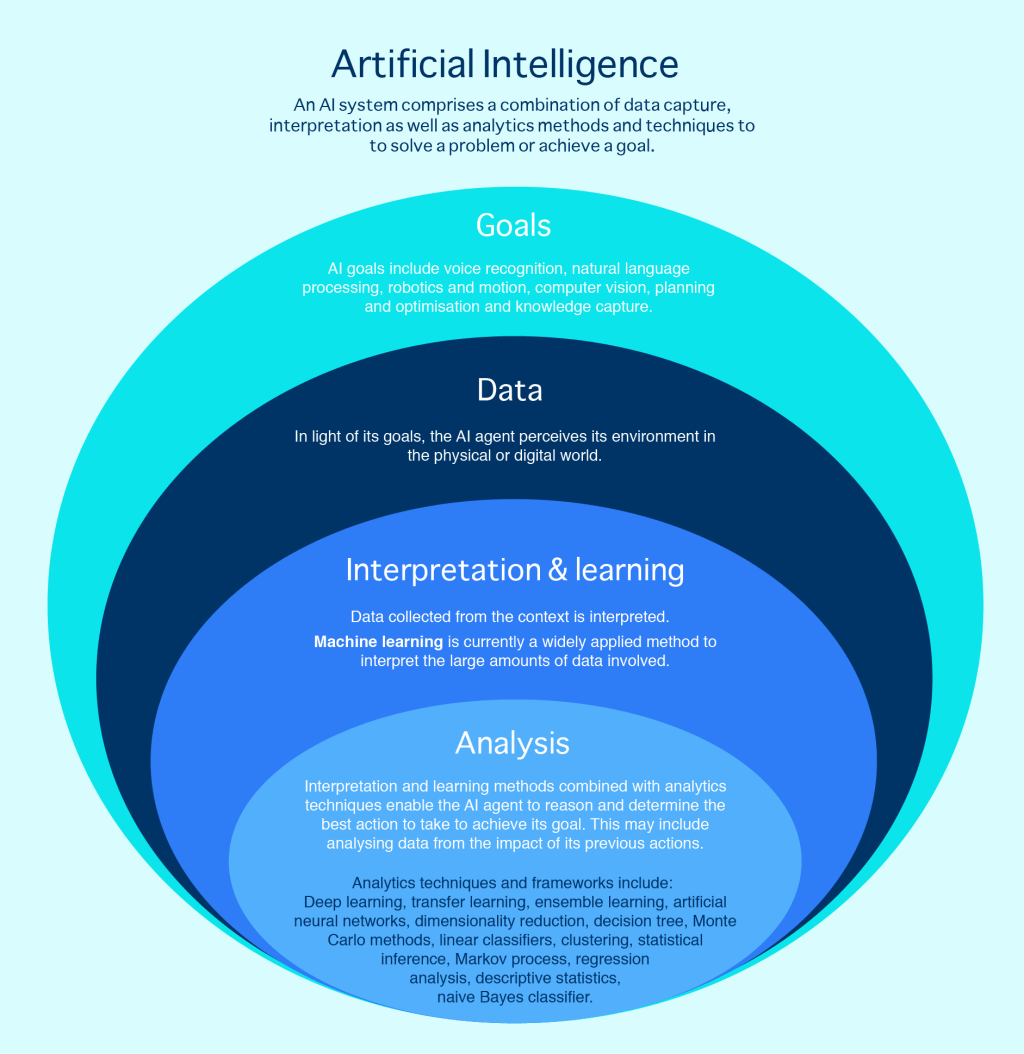
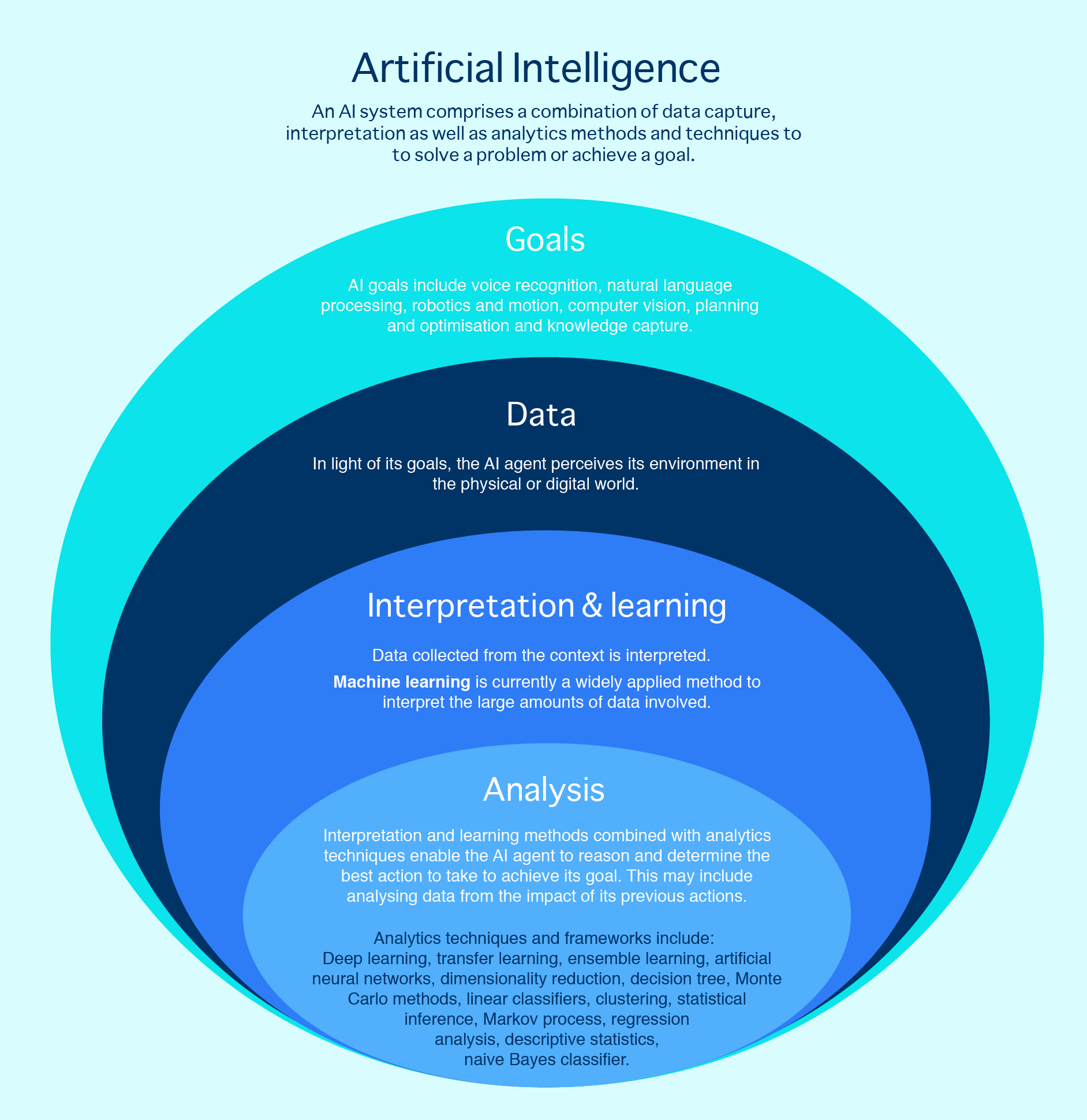
Artificial intelligence involves a series of methods that can create intelligence in machines. It is not new, with many of the foundational concepts having emerged in the 1940s and 1950s. Over the last 10 years significant advancements in computational power, data capture and associated costs have enabled an unprecedented wave of AI activity.
The European Commission’s definition is helpful as a foundational understanding:
“Artificial intelligence (AI) refers to systems designed by humans that, given a complex goal, act in the physical or digital world by perceiving their environment, interpreting the collected structured or unstructured data, reasoning on the knowledge derived from this data and deciding the best action(s) to take to achieve the given goal.”
Creating AI
The creation of artificial intelligence has been significantly based on complex mathematics. It involves the processing of data according to rules or instructions and the identification of patterns to make predictions. A software agent must perceive, interpret and reason in order to take the best action towards achieving its goal.
As a component of AI systems, machine learning is a common method being applied today. Types of machine learning include supervised learning, unsupervised learning, semi-supervised learning, and reinforcement learning. There are many techniques and subsets of machine learning; in current use cases reinforcement learning, deep learning and transfer learning are prominent examples.
Potentials of AI
Artificial narrow intelligence — All AI achieved thus far has been in the realm of narrow AI. Systems that display a degree of intelligence through performing one specific task or within a particular environment. Applications of narrow AI include internet search engines, social media feeds, product recommendations, email spam filtering and device voice assistants.
Artificial general intelligence — Artificial General Intelligence (AGI) refers to a system with a full range of human cognitive abilities making it able to cope with any generalised intellectual task that a human is capable of. There are many open scientific and technological challenges to build the capabilities needed to achieve general AI. One survey taken of over 300 AI researchers in 2017 predicted a 50% chance of artificial general intelligence being achieved by 2060.
Super intelligence — Some researchers believe that through the achievement of artificial general intelligence a much higher order level of intelligence will come to fruition; a superintelligence. Philosopher Nick Bostrom argues that we should be making efforts towards reducing the risks of superintelligence, such as through instilling human values into AI.
Looking forward
Narrow artificial intelligence is already being implemented across industries, with problems AI methods are being applied including optical character recognition, speech recognition, facial recognition, computer vision, robotics, medical diagnosis, computer gaming and judicial decision making.
AI development is primarily being driven by private for-profit enterprises, however the technology is also being applied to address broader societal challenges. AI use cases can be found for all of the United Nations Sustainable Development Goals, with the most prominent being AI applications for health and wellbeing, peace and justice, and quality education.
 Tina Gallico