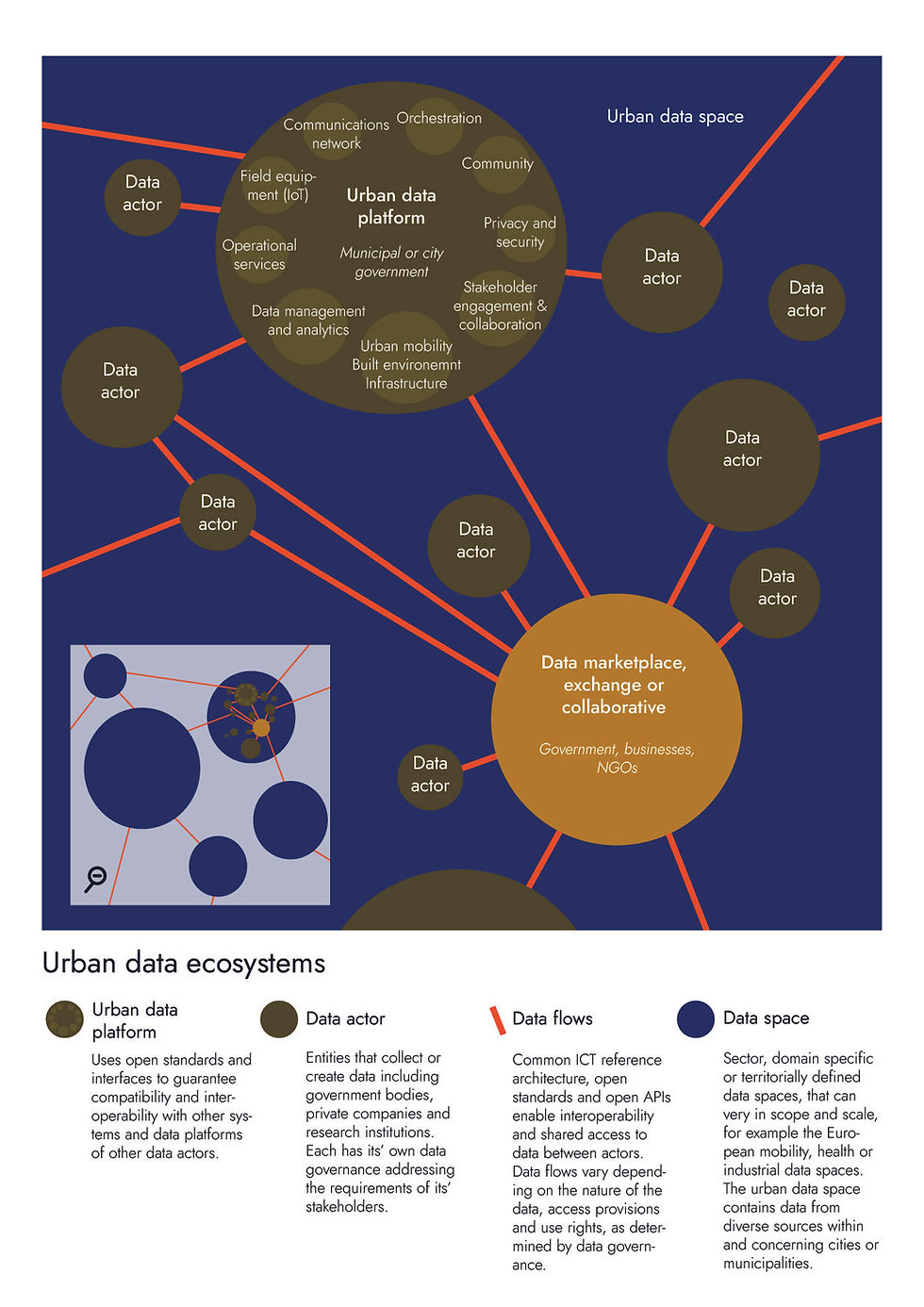
Urban data concepts and frameworks being developed and implemented in European cities to enable urban data ecosystems.

Insights
1/ Cities are a key data generator of our times. Fábio Duarte and Ricardo Álvarez of MIT Senseable City Lab provide an excellent discussion of cities as data generators and opportunities therein, and conclude the challenge is finding the necessary balance between data-driven approaches with socially critical views.
2/ The European Union has been paying increasing attention to supporting the data driven economy and creating models for technology to enable human centered, sustainable cities. The European Data Strategy aims to create a single market for data that will ensure Europe’s competitiveness, empower businesses and the public sector through data utilisation whilst maintaining human centric values and rights.
3/ With suitable data infrastructure, cities can facilitate urban data ecosystems. Data infrastructure in this sense refers to physical, digital, organisational and governance structures and processes needed for the management of data. For public administrations it includes the connectivity, data generating assets, data operating systems and platforms.
4/ For cities, urban data ecosystems can pool and utilize data from various sources to develop applications that improve the efficiency of city services, public infrastructure and resources, reduce pollution and congestion, lower costs through risk prediction as well as support innovations in the broader economy.
The concept of the urban data space encompasses the characteristics of what I call an ‘urban data ecosystem’. Urban data ecosystems are systems within wider systems of our digitised world. They cannot thrive in isolation from simultaneously developing data sources, flows, and networks, of other urban agglomerations or data spheres at the national or global level.
5/ In Europe, central elements emerging so far for developing urban data ecosystems include data spaces, common ICT Reference Architecture for open urban platforms and open standards.
Urban data spaces — Researchers at the Fraunhofer Institute for Open Communication Systems (FOKUS) and Technical University of Berlin provide an excellent proposition for urban data spaces at the municipal level in Germany.
Data marketplace or data exchange — Whilst there are many cities with open data websites, few data marketplaces or exchanges have been established where data from all city stakeholders can be bought, sold or transferred. The Municipality of Copenhagen has been piloting a City Data Exchange with the Capital Region of Denmark and Hitachi.
Reference architecture — ICT reference architectures are the backbone of digitised urban governance. The EIP SCC has developed a common technically agnostic reference architecture for public administrations based on standards for interoperability and vendor neutrality.
6/ European lighthouse projects — Many cities are piloting projects and have implemented aspects of the urban data ecosystem with the intent to further develop and expand capabilities, including the EU initiatives Sharing Cities and RUGGEDISED.
7/ London’s urban data ecosystem — Outside of EU funded lighthouse projects, the Greater London Authority (GLA) continues to pursue an ambitious program to foster a strong data ecosystem in London. London has more advanced digital technology companies than any location in Europe, including more AI and IoT startups and scaleups than all of Germany and France combined.
8/ Outlook — Whilst progress on creating urban data ecosystems has occurred across Europe, EU funding assistance has been the primary enabler. The EU aims that “300 million European citizens are served by cities with competent urban data platforms, by 2025.”
Interview with Dr.-Ing. Nikolay Tcholtchev, Senior Researcher, Fraunhofer FOKUS
After reading the paper he co-authored on urban data spaces I was curious about progress made in open urban platforms and urban data spaces in Germany since 2018 and how it is being further developed.
tg: In the 2018 research paper on urban data spaces, several shortfalls in European and German local governments were identified that act as barriers. Let’s start with the lack of comprehensive knowledge about the data available in municipal organizations.
NT: There has been progress in this area given the various formats for information exchange between municipalities and stakeholders on German and European level. The Morgenstadt framework of Fraunhofer with its Urban Data Partnership (UDP) platform has started enabling the interactions between different municipalities in order to work out best practices, to study relevant use cases and to explore suitable data formats towards the efficient sharing and publishing of data from municipal organisations. On European level, initiatives such as Living-in.eu, Open Agile Smart Cities (OASC) and the EIP SCC have been establishing the dialogue process towards sophisticated understanding of the data availability and sharing practices within cities and communities.
tg: The final barrier identified in the research paper was a lack of concrete business models for sustainable data exploitation by municipalities.
NT: The quest for the business models continues to be cumbersome from my perspective. However, a number of companies already manage to create and successfully run business models in urban environments. Hence, data is obviously creating businesses and revenue, which indirectly bring benefits to the municipalities by increasing the quality of life and the tax revenues in particular areas.
tg: What would be ideal actions or priorities to start with for public administrations that would like to move in this direction?
NT: The following points are perceived as necessary: identify data sets, establish processes for data governance and data sovereignty, identify relevant data formats, identify and deploy relevant open source solutions, and extremely important: invest in education of the personnel. Educate and help the civil servants to become efficient digital experts contributing to our digital future.

READ — For critical voices on the emerging relationship between data and urbanism, the latest issue of ARCH+ has informative and thought-provoking essays and interviews exploring the datafication of cities framed by Marxist critique of the production of space.
 Tina Gallico