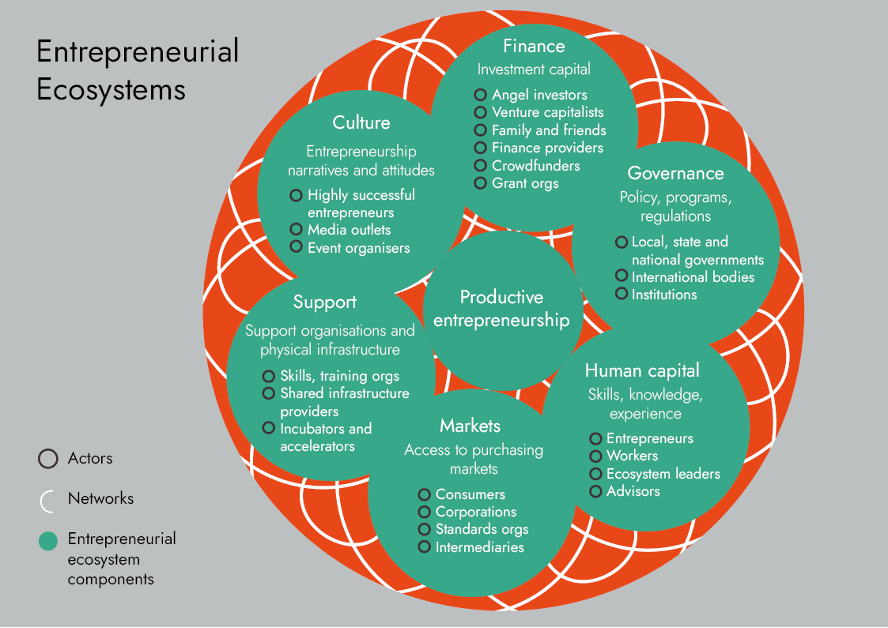
Empowering Digital Social Innovation and Entrepreneurship actors could create entrepreneurial ecosystems that enable Tech for Good.
Entrepreneurial ecosystems are networks of actors and attributes that enable entrepreneurial activity within a given context. Their interdependent actors including individuals, groups, organisations and institutions alongside infrastructure and resources are coordinated in a way that is conducive to productive entrepreneurship, such as the emergence or growth of ventures.
They are dynamic and complex, involving embedded and overarching systems that can be framed by territorial scale e.g., national, city, campus, as well as other characteristics e.g., sectorial, technology, investment.
Innovation and entrepreneurial ecosystems
There is significant overlap between innovation ecosystems and entrepreneurial ecosystems. They both concern dynamic webs of actors (organisations and individuals) and networks which enable or hinder innovative or entrepreneurial endeavors. Many attributes and actors involved are the same for innovation and entrepreneurship to flourish in a given context, such as universities, talent, capital and information flows. However in my view, whilst innovation ecosystems focus on generating novel intellectual property, products or services, entrepreneurial ecosystems provide the building blocks for taking innovations to market and successfully building viable businesses. So while innovation ecosystems lean towards knowledge generation, entrepreneurial ecosystems lean towards capitalisation of knowledge outcomes.
Digital social innovation and entrepreneurship
Digital social entrepreneurship strives for the creation of blended value with financial and social returns through utilizing technology. Popularly referred to as tech for good and overlapping with digital social innovation, digital social innovation and entrepreneurship has been recognised by the European Union as a significant opportunity to implement policy goals across domains including sustainability, digital sovereignty and economic competitiveness.
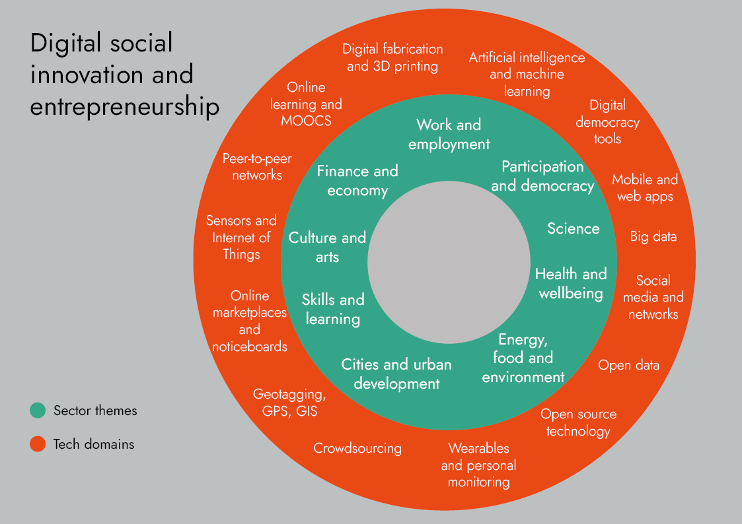
Various research programmes and pilot projects to support digital social entrepreneurship ecosystem building have been funded within the framework of the Digital Agenda for Europe and the Horizons 2020 Programme. Key challenges for building digital social innovation and entrepreneurship ecosystems in Europe include access to finance, skills shortages and getting to scale.
Supporting digital social entrepreneurship to enable Tech for Good
In order to support digital social entrepreneurship we need to better understand how the agency of digital social entrepreneurship actors might be supported to contribute to the growth of digital social entrepreneurial ecosystems, as part of broader entrepreneurial ecosystems in cities and regions.
Based on entrepreneurial ecosystems as complex systems that culminate to provide a differing environment for innovation and entrepreneurship in each given location or context, there is no way to ‘master plan’ or control the ecosystem or its components. Any single intervention, whether it be policy or otherwise will not demonstrate a direct cause and effect as there are so many variables at play.
A more effective way to understand the health of innovation and entrepreneurial ecosystems is to take a qualitative approach at the micro level in order to steer attention to be paid to macro indicators and quantitative metrics. The latter are notoriously misused when deployed as indicators of a start up ecosystem’s health, with easily measured metrics such as venture capital deals or unicorn valuations considered indicators of an ecosystem’s current health rather than weighing these against other indicators that demonstrate the long-term viability of innovation and entrepreneurship in a society.
 Tina Gallico